

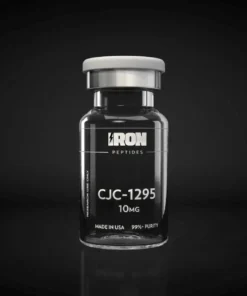
What is CJC-1295 (10MG)?
CJC‑1295 – No DAC, also known as Modified GRF (1‑29), is a synthetic 29-amino acid analogue of endogenous growth hormone–releasing hormone (GHRH). It was developed to resist enzymatic degradation and mimic the physiological pulsatile release of growth hormone in laboratory research [1][2].
Chemical Structure of CJC-1295 (10MG)
This peptide retains the first 29 amino acids of endogenous GHRH but with four strategic amino acid substitutions—most notably D-Ala at position 2, and substitutions at positions 8, 15, and 27—to enhance stability [3]. The sequence (Tyr-D-Ala-Asp-Ala-Ile-Phe-Thr-Gln-Ser‑Tyr‑Arg‑Lys‑Val‑Leu-Ala-Gln-Leu-Ser-Ala-Arg-Lys-Leu-Leu-Gln-Asp-Ile-Leu-Ser‑Arg‑NH₂) exhibits a half-life around 30 minutes, supporting its use in repeated or pulsatile dosing regimens in research applications [3].
What Are the Effects of CJC-1295 (10MG)?
Growth Hormone Secretion :
Acts on GHRH receptors at the anterior pituitary, inducing pulsatile growth hormone release in animal and human research models, similar to endogenous GHRH [2].
Short-Acting Profile :
Its ~30-minute half-life avoids prolonged GH elevation, enabling controlled, repeatable research dosing paradigms [2].
Metabolic & Tissue Effects :
Preclinical and early human investigations link its use with enhanced lean tissue synthesis, improved metabolic markers, accelerated tissue repair, and modulation of bone turnover, reflecting effects typically mediated by endogenous GH [2][4].
Synergistic Research Use :
Frequently combined with growth hormone secretagogues (e.g., GHRPs) to mimic physiologic GH pulses, optimize metabolic endpoints, and study recovery dynamics in lab models [4].
Safety Profile in Research :
Studies suggest predictable endocrine responses with minimal off-target effects, making it suitable for controlled experimental protocols [2][4].
Citations
- PubChem Compound Summary for Modified GRF (1‑29) (CID 68549693), “Mod GRF 1‑29 is a synthetic analogue of GHRH with specific amino acid modifications to enhance stability.”
- Soule S, King JA, Millar RP. Incorporation of D-Ala2 in growth hormone-releasing hormone-(1-29)-NH₂ increases half-life and decreases clearance in healthy adults. J Clin Endocrinol Metab. 1994;79(4):1208–1211. PMID: 7962295.
- Wehrenberg WB, Ling N. In vivo biological potency of rat and human growth hormone-releasing factor and fragments of human GHRH. Biochem Biophys Res Commun. 1983;115(2):525–530. PMID: 6414471.
- Exploring‑Peptides.com: Mod GRF 1‑29 Peptide Profile – summary of effects on GH release, metabolism, and tissue repair in research.
Related products
Vial
Vial
Vial
Vial
Vial
Vial
Vial
Vial