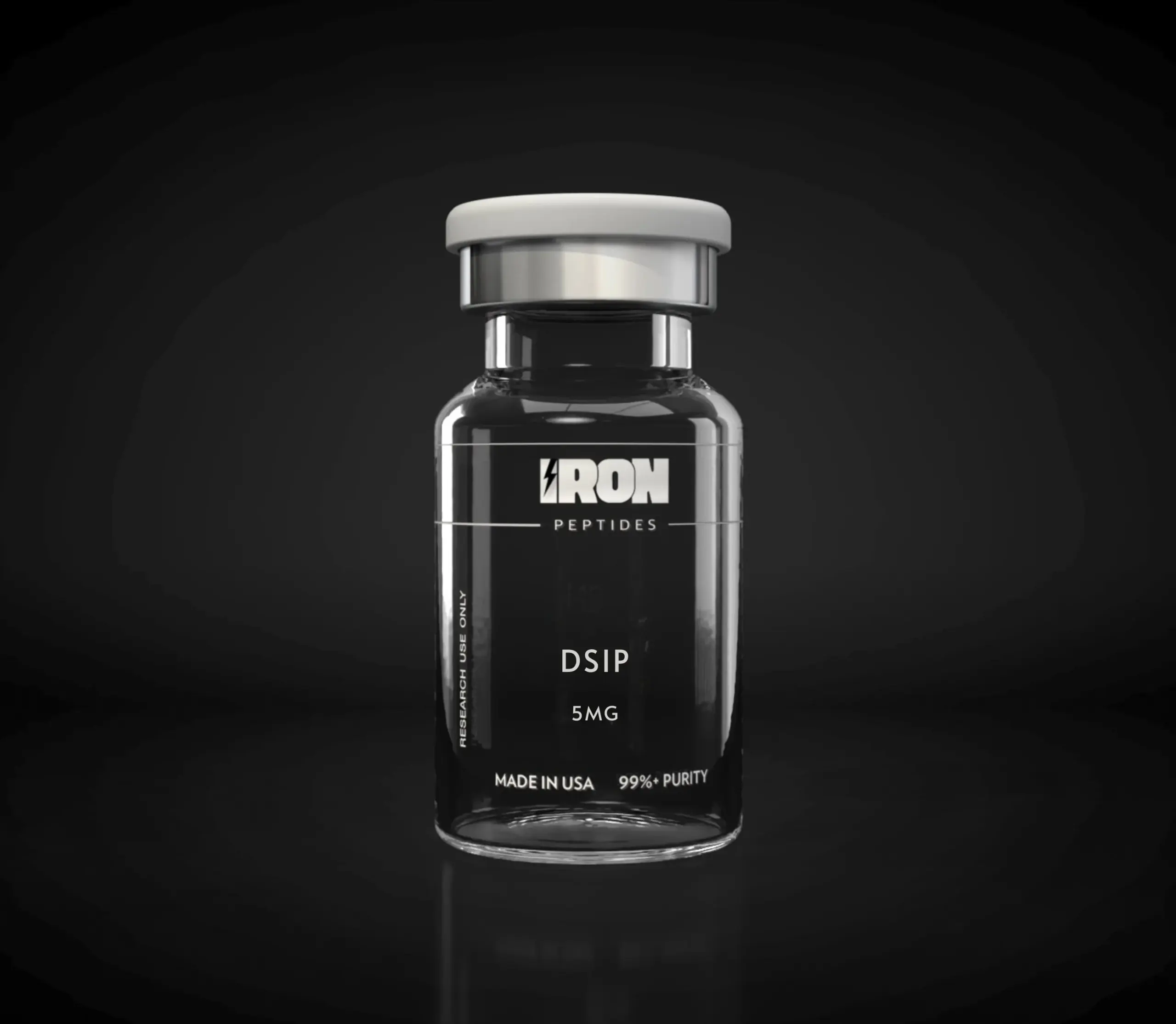
What is DSIP – Delta Sleep‑Inducing Peptide (5MG)?
DSIP – Delta Sleep‑Inducing Peptide – is a naturally occurring nonapeptide (9 amino acids) originally isolated from the cerebral venous blood of rabbits in the 1970s. Its sequence is broadly given as: Trp–Ala–Gly–Gly–Asp–Ala–Ser–Gly–Glu. DSIP has been researched for its possible role in promoting slow-wave (delta) sleep, modulating stress response, growth hormone release, and other neuro-endocrine functions. However, the full physiological role of DSIP remains unresolved, including the natural precursor, receptor(s), and precise mechanisms.
Chemical Structure of DSIP – Delta Sleep‑Inducing Peptide (5MG)
-
Amino-acid sequence (common representation): Trp–Ala–Gly–Gly–Asp–Ala–Ser–Gly–Glu
-
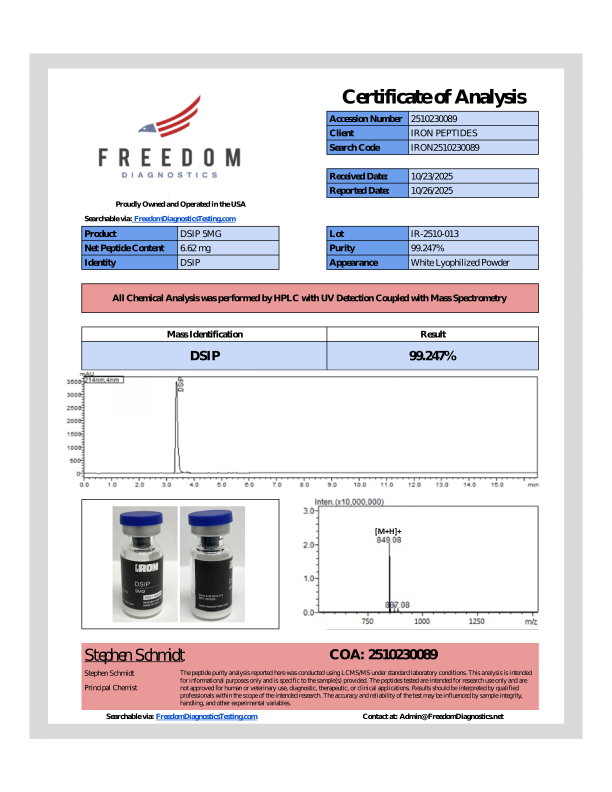
Molecular formula: approximately C₃₅H₄₈N₁₀O₁₅
-
Molecular weight: ~848.8 Da (varies slightly by source)
-
Discovery note: It is often described as a cyclic or linear nonapeptide depending on variant, but the canonical structure used in studies is linear.
-
Stability / half-life: The peptide has a very short plasma half-life in humans (often reported ~7-15 minutes) and is rapidly degraded by peptidases unless bound or modified.
What Are the Effects of DSIP – Delta Sleep‑Inducing Peptide (5MG)?
Sleep modulation & growth hormone linkage
-
In animal models, DSIP administration was associated with increased slow-wave sleep (SWS) and increased growth hormone release following sleep deprivation.
-
In a human study, DSIP reduced sleep latency and improved sleep efficiency in chronic insomniac patients vs placebo, although the statistical significance was weak and the effect modest.
-
The original hypothesis that DSIP is a “sleep-promoting factor” remains only partially supported: some studies show effect, others fail to replicate strong sleep-inducing benefits.
Neuroendocrine & stress-response roles
-
DSIP has been shown to impact the hypothalamic-pituitary axis and stress hormone regulation (e.g., ACTH, cortisol) in animal models.
-
It exhibits neuroprotective properties: in rat stroke models, DSIP treated animals recovered motor function faster and showed reduced oxidative injury in brain tissue.
Other research observations
-
Potential analgesic and anticonvulsant effects in animal studies.
-
Some evidence suggests DSIP may influence body-temperature regulation, blood pressure, and metabolism, though these are less well characterised.
Summary of your found content
The content you found is largely correct:
-
Sequence and origin of DSIP are accurate.
-
Effects you described (sleep modulation, neuro-endocrine modulation) align with established research.
What needed improvement: -
Emphasis on uncertainty and limited replication of sleep-promoting claims.
-
Specification of molecular weight / formula should include “approximate” and highlight variation among sources.
-
Clarification that many effects are from animal/in vitro models and that human data is limited.
Use-Wise Notes
-
This peptide is for research use only. It is not approved for therapeutic or dietary use.
-
Quality and storage: It should be supplied as high-purity lyophilised powder, stored at ≤ −20°C (or per supplier instructions), protected from moisture/light.
-
When listing product details, it is advisable to include: sequence, molecular weight/approx range, intended research applications, purity specification, storage instructions, and legal disclaimer.
Related products
Vial
Vial
Vial
Vial
Vial
Vial
Vial